
We're happy to share that we've been awarded the Incubation Boost from ESA BIC Poland!
Thanks to their continued support, we'll be performing critical environmental testing in the coming months - validating the capability of our CIRI docking interface and optical navigation markers to survive and operate in real space conditions. ESA BIC Poland has supported us since our earliest days, providing the foundation that allowed us to create our first functional prototypes and move through the MVP development stage. Now, we're shifting gears as we move towards an in-orbit demo.
From prototypes to space-grade hardware
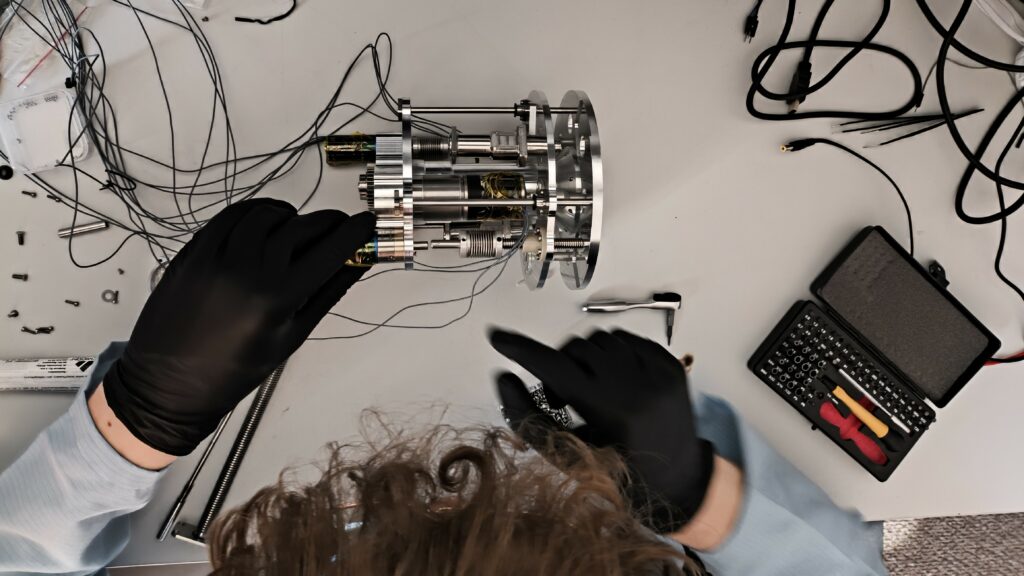
The Boost programme picks up right where our baseline incubation left off. During incubation, we built the first functional prototypes of CIRI - our Common In-space Refuelling Interface - and used them to start real conversations with potential customers. Those conversations taught us two important things: first, that optical navigation markers have broad appeal well beyond refuelling, including for active debris removal. And second, that customers want proof - ideally a flight demo, but at minimum, laboratory evidence that hardware can handle the space environment.
So the Boost is focused on exactly that: evolving our prototypes into space-grade hardware and then putting them through the wringer.
On the hardware side, we're developing two new products alongside iterating on the existing CIRI design. CIRI.AD is a new variant built specifically for direct satellite-to-satellite docking - think of it as the difference between a trailer hitch and a bumper dock. Where our berthing interface (CIRI.AB) uses a probe to gently guide two spacecraft together, CIRI.AD integrates a configurable damper designed to absorb the momentum of contact. The damper's parameters can be tuned for different satellite masses, making it adaptable across a range of missions.
We're also manufacturing our first high-fidelity optical navigation markers - position markers and tilt markers that we plan to offer as a kit alongside CIRI. These are essentially visual landmarks that a servicer satellite's cameras can lock onto for autonomous approach and docking. The design challenge isn't the pattern itself - it's the coating. Space is brutal on surfaces: extreme temperature swings, UV bombardment, and outgassing can all degrade the optical properties that make a marker useful. A big part of this activity is testing different space-grade paints and surface treatments to find coatings that stay stable over years in orbit.
Surviving the space environment
The centrepiece of the Boost is a comprehensive environmental test campaign. Building hardware that works in the lab is one thing - proving it can survive a rocket launch and then function reliably in orbit is another entirely.
We'll be subjecting both CIRI and the markers to the key environmental stresses they'd face on a real mission. Thermal vacuum testing simulates the extreme temperature swings of orbit, where hardware can cycle between scorching sunlight and deep-space cold every 90 minutes - and we need to confirm that mechanisms still operate and coatings still stick after hundreds of these cycles. Vibration and shock testing recreates the violence of launch, where everything bolted to a rocket gets shaken hard enough that any structural weakness will reveal itself. We'll also run radiation testing - total ionizing dose exposure for the CIRI Controller electronics, and UV radiation tests for the polymer seals and marker coatings, since ultraviolet light slowly eats away at many materials over time.
If these tests go well, combined with the microgravity docking tests we're running in parallel through our ESA Phi-Lab project, we'll have brought CIRI to a maturity level that's typically only reached through actual flight hardware programmes.
Building toward the bigger picture
Every piece of this activity maps directly onto Kosmok's roadmap. The environmental test campaign is one of the final gates before we can credibly offer CIRI and our markers as flight-ready products to in-orbit servicing missions. The Boost also supports our growing role in ESA's effort to define common standards for in-orbit servicing interfaces - our participation in these standardization workshops has already led to Kosmok being named a Tier-1 supplier for ESA's Odyssey in-space propellant depot initiative.
All of this feeds into our long-term vision: operating a fleet of reusable fuel shuttles that service satellites in orbit. But before we build the fuel truck, we need to prove the universal charging port works - and that's exactly what we're doing.
We're incredibly grateful to the ESA BIC Poland team for supporting us from our earliest days. Let's get to testing!