
It's official: our ESA Phi-Lab Poland project is a go!
We spent today at Poznan University of Technology for the kick-off meeting of ADONIS - our Autonomous Docking and On-orbit Navigation Integrated System project. It was great to share our roadmap, meet the wider Phi-Lab team, and check out the facilities where we'll be running our tests - including the Microgravity Laboratory where we'll validate our docking hardware in simulated zero-g conditions.
Truth is, we've been working on this behind the scenes for months - writing the proposal, iterating on our technical approach, and aligning everything with our broader product roadmap. But it feels great to finally launch.
What is ADONIS?
ADONIS is a research and development project funded through the ESA Phi-Lab Poland programme, managed by Poznań University of Technology. It targets two critical enabling technologies for in-orbit servicing: autonomous navigation and docking.
Think of it this way - if in-orbit servicing is the future equivalent of roadside assistance for satellites, then ADONIS is building the self-driving system and the universal charging port that make the tow truck work.
Teaching satellites to see
The first track of ADONIS is about giving satellites the ability to find and approach each other autonomously — using nothing but cameras and clever software.
Today, most rendezvous systems rely on LIDAR combined with multiple sensor types. LIDAR works well, but it's heavy, power-hungry, and expensive - a single unit can weigh over 12 kg and consume up to 100W, which is a serious budget for a small satellite. It's a bit like needing a full radar suite just to parallel park.
We're taking a different approach. Using deep learning models trained on both real and synthetic imagery, we're developing an optical navigation system that can estimate the relative position and orientation of a target satellite from camera images alone. We combine visual markers - think QR codes designed for space - with structural feature detection to build a system that's robust even when lighting conditions change dramatically, as they constantly do in orbit.
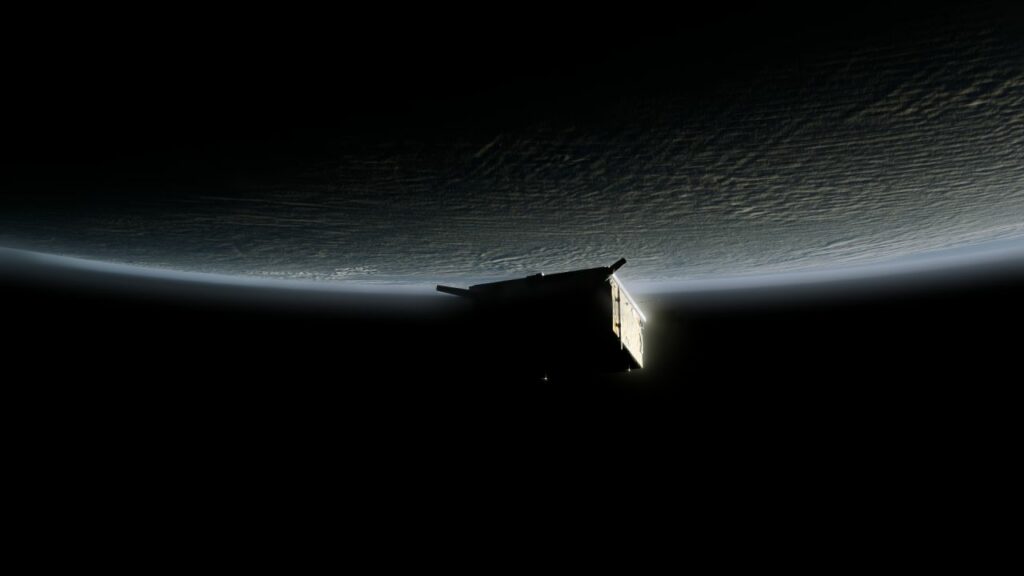
To teach AI to do this, we need data to train on, which is hard to come by for satellite docking. To cross this gap we're building two simulators that will help generate it: a physical lab setup with controlled lighting and a gimbal-mounted target, and a software renderer producing synthetic in-orbit imagery.
Docking in (simulated) zero gravity
The second track is all about physical contact - specifically, testing our Common In-space Refuelling Interface (CIRI) in conditions that actually resemble space.
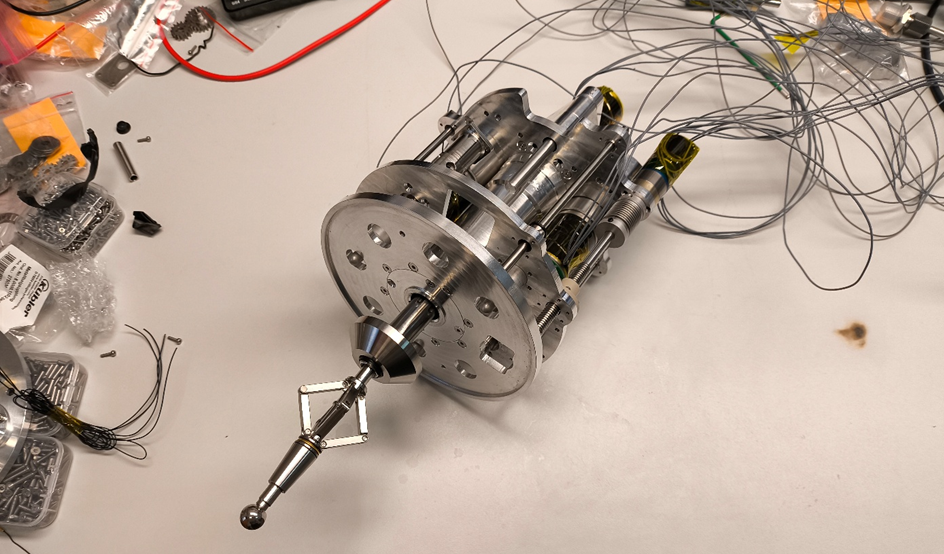
Docking two satellites is mechanically complex. The physics of two free-floating objects making contact, latching, and forming a sealed connection involves forces and dynamics that are extremely hard to model accurately - and even harder to test on Earth, where gravity distorts everything. It's like trying to practice catching a ball underwater by rehearsing on dry land.
The Microgravity Laboratory at ESA Phi-Lab Poland gives us a rare opportunity: a flat-floor, air-bearing facility where hardware floats on a frictionless surface, simulating 2D microgravity. We'll use it to run a test campaign on our CIRI prototypes - the docking and refuelling mechanisms we've been developing since our ESA BIC incubation - and correlate the results against high-fidelity multibody dynamics simulations. If both this campaign and a parallel environmental test effort succeed, we'll have brought CIRI to a level of maturity that's hard to achieve without access to actual orbit.
And here's where the two tracks come together: during the docking tests, cameras and markers mounted on the hardware will capture image sequences of real approach and docking manoeuvres - feeding directly back into the navigation algorithm as training data.
The bigger picture
ADONIS isn't just a standalone research exercise, but a direct building block on Kosmok's roadmap toward in-space refuelling.
Our long-term vision is to operate a fleet of reusable fuel shuttles that pick up propellant from orbital depots and deliver it to satellites that need it - like a fuel delivery service, but in space. That service depends on two things: the ability to autonomously find and approach a client satellite, and a universal interface to physically dock and transfer fuel. ADONIS develops both.
In the near term, these technologies are our first product offering. Docking mechanisms, optical markers, and navigation algorithms are capabilities that the entire in-orbit servicing industry needs - not just us. By making them available, we're lowering the barrier to entry for both service providers and satellite operators who want to make their hardware serviceable. The goal is to help kickstart a cooperative in-orbit ecosystem, not build a walled garden.
There's also a standards angle. The European space industry is in the early stages of converging on common interfaces for in-orbit servicing — and we think the process needs more systematic, data-driven comparison of different approaches rather than just a patchwork of existing solutions. The data we generate through ADONIS feeds directly into that effort.
Follow along
We'll be sharing updates as the project progresses - from algorithm benchmarks to zero-g docking footage. Stay tuned.